16 amber beads in the grave of a woman and a child
Some numbers appear often in archaeology. Fifty vessels. Two brooches. One sword. They sound like catalogue entries. Like another line in an excavation report. Like ordinary data.
But sometimes a more persistent number comes along. Sixteen. Sixteen amber beads.
And suddenly you stop thinking about archaeology and start thinking about people.
The grave at Zamiechów
Archaeologists studying the site at Zamiechów in Subcarpathia discovered not only traces of an amber workshop from the Roman Period. They also came across an exceptional burial of a woman and a child. Its grave goods included 16 amber beads. The authors of the study stress that this is an exceptionally rare find for cemeteries of the Przeworsk culture, which practised mainly cremation. Many objects were placed on the funeral pyre and destroyed. That is why well-preserved amber ornaments are a rarity.
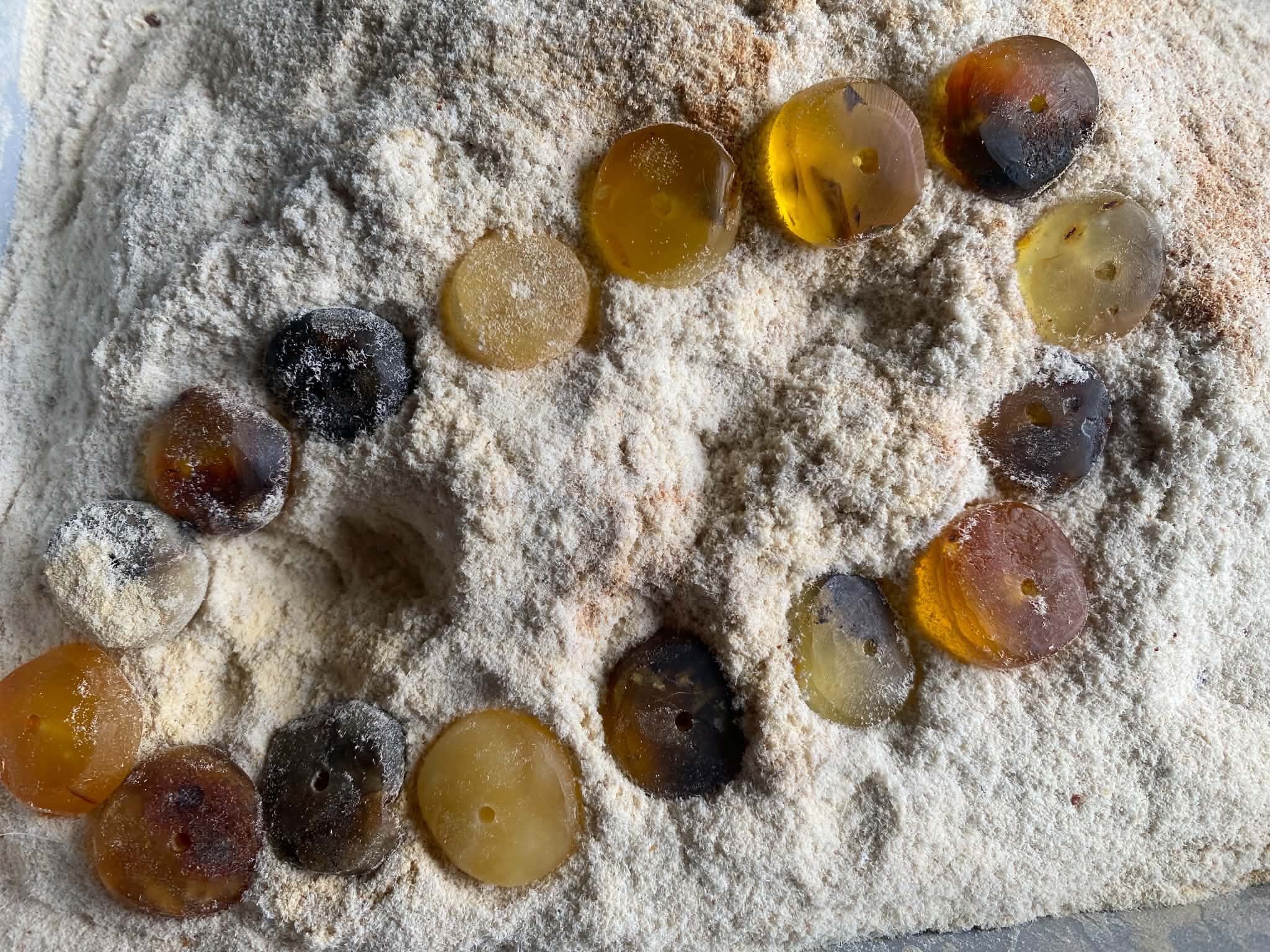

Archaeology knows the number. It does not know the story
Archaeology is very good at counting beads. It is much worse at answering questions. Who was this woman? Who was the child? Were the amber beads part of a necklace? Were they a family keepsake? Were they meant to protect the dead? We do not know.
What we do know is that someone decided to place them in the grave. And that moment seems the most interesting. Because the amber did not end up there by chance. Someone decided that it should accompany the dead after death as well.
Amber as more than an ornament
Since the earliest times, amber has been given meaning beyond its decorative value. In many cultures it was made into amulets, figurines and protective objects. Amber was credited with healing and magical properties, and in the Mediterranean world it was a particularly prized and coveted material.
So the 16 beads may have been more than jewellery. Perhaps they were part of a necklace.
Perhaps they were a sign of status. Perhaps they were an amulet.
Or perhaps all of these at once.
That can no longer be established.
Memory
Over almost two thousand years, the world has changed. Religions have changed. States. Borders. The languages in which people told each other the story of life and death have changed.
What has not changed is the need to keep important things.
That is why it is hard not to think about these sixteen amber beads in a more personal way as well.
Because everyone knows similar objects.
A grandmother’s beads.
A mother’s ring.
A father’s cufflinks.
Objects whose value is hard to estimate, because it is measured neither by weight nor by the price of the metal. Their value comes from the fact that someone wore them. That they passed from hand to hand. That they were left behind by someone who is no longer here.
Perhaps that is why amber also found its way into the grave of the woman and child at Zamiechów.
It may have been an ornament. It may have been an amulet. It may have been a keepsake.
We do not know.
What we do know is that someone considered it important enough not to part with it even after death. And when the beginning of November comes, such a gesture is easy to understand.
Because memory very often lives in small objects.
Sometimes in a medallion. Sometimes in an old watch. Sometimes in an amber bead.
This piece was written after reading the article “Amber workshops in central Poland during the Roman Period” by Adam Cieśliński and Marcin Woźniak, which describes Przeworsk culture amber workshops and the grave of a woman and a child at Zamiechów furnished with 16 amber beads. The interpretation presented in the text is the author’s own and literary in character.

Amber and the Moirai in Zakopane
Modern Eyeglass Frames